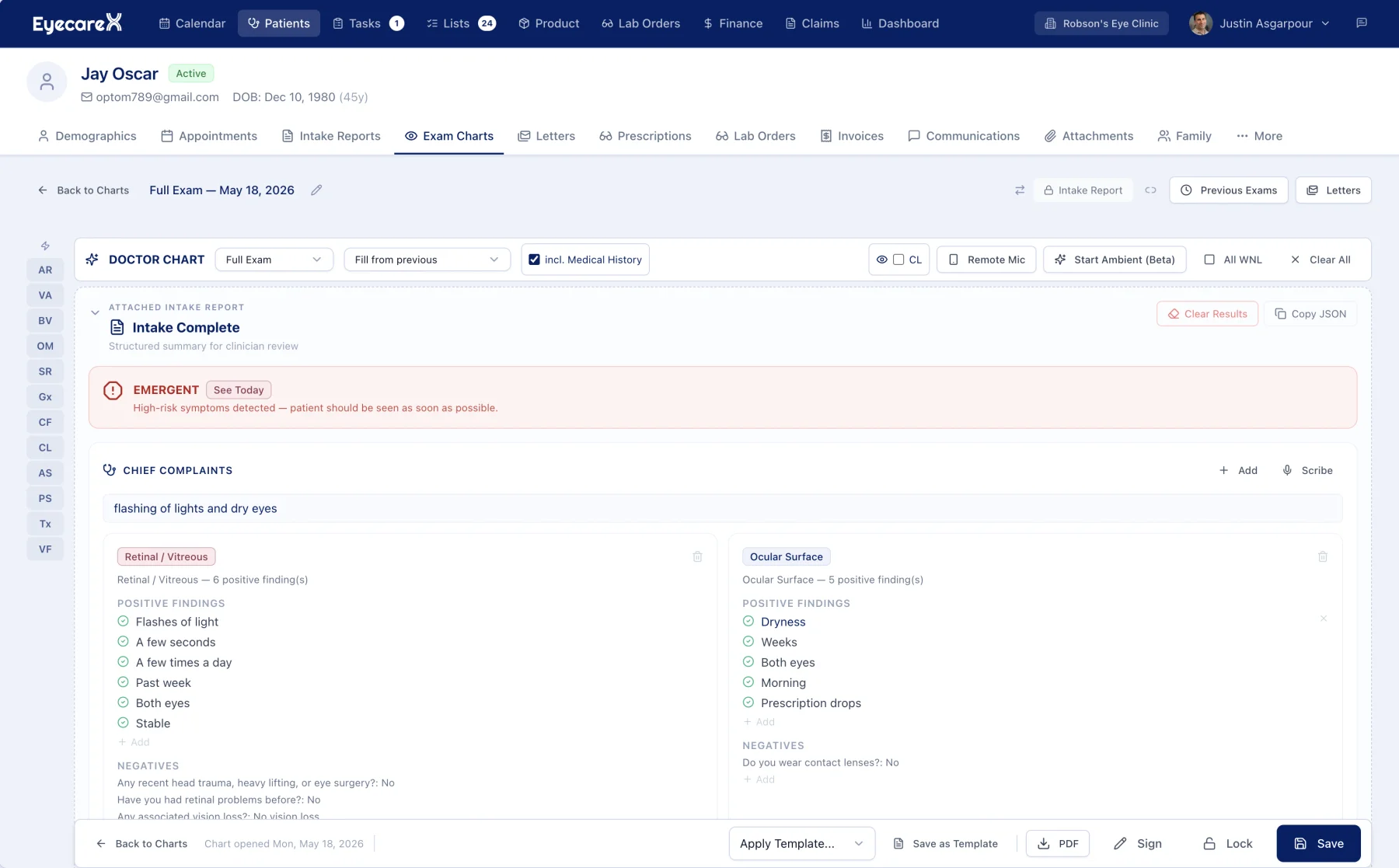
Most optometrists didn't go to school to type. Yet for many, the last hour of every clinic day (and often part of the evening) belongs to unfinished charts. AI scribes exist to give that hour back.
This post explains what an AI scribe actually does in an optometry exam, how it differs from dictation, and what to check before you trust one with your documentation.
What an AI scribe does
An AI scribe listens to the natural conversation between you and your patient during the exam. From that conversation, plus the structured data already in the chart, it drafts:
- The exam note, in your clinic's format
- Patient instructions and education summaries
- Referral and report letters
- Suggested billing codes for the visit
You review, edit if needed, and sign off. The critical distinction: a good system drafts, the doctor decides. Nothing should be saved to the record or submitted for billing without your approval.
This is not dictation
Dictation software has been around for decades, and it made doctors faster typists at best. You still had to narrate the note yourself, section by section, after the patient left.
An AI scribe is different in two ways:
- It works during the exam, not after. The conversation you were already having is the input. There is no second pass.
- It understands structure. "The right eye is 20/20, left is 20/25 plus two" lands in the acuity fields, not in a wall of text. Findings go where findings belong, so prior-visit comparison still works.
What it means in practice
Clinics using AI charting consistently report the same three changes:
- Charts are done when the patient leaves. The note is drafted and ready for review before the next patient sits down.
- Eye contact comes back. Nobody is typing into a screen mid-exam, which patients notice more than any piece of equipment in the room.
- Documentation gets more complete, not less. The scribe doesn't forget to record the conversation about digital eye strain because the schedule was running behind.
In EyecareX, the scribe is built into the chart itself rather than bolted on, so drafts land directly in the right sections and billing codes are suggested from the actual findings.
Questions to ask before adopting one
Not all AI scribes are built for eye care, and not all handle clinical data responsibly. Before adopting one, ask:
- Is it optometry-specific? General medical scribes stumble on refraction, prism, and contact lens terminology.
- Where does the audio go? Look for processing that meets PIPEDA and HIPAA requirements, with data hosted in Canada for Canadian clinics.
- Do you review before anything is saved? The doctor must remain the final author of the record.
- Does it integrate with your chart, or does it produce a text blob you paste in manually? Integration is where the time savings actually live.
- What happens when it's wrong? Editing a draft should be faster than writing from scratch, or the tool isn't paying for itself.
The bottom line
AI scribing is the rare technology that removes work instead of adding a system to manage. If charting is the reason your team stays late, it is the first AI feature worth evaluating, and the easiest one to measure: count the minutes from "patient leaves" to "chart signed" before and after.
See EyecareX in action
Optometry practice management software that automates charting, recalls, billing, and pre-visit testing.
Book a Demo